Haste Makes Waste: Act More, Compare Less
1 Rushed, Anxious, Angry
Compared with the sad, gloomy kind of anxiety I used to feel, today (or lately) mine leans toward the impatient, frustrated kind. Sadness and gloom breed self-doubt, dull desire, and hold you back from acting. Anger and impatience, on the other hand, sharpen the craving for results, but bring rushed action, lost patience, and haste. From this I realized: the slower you go, the faster you get there — just like the tortoise and the hare.
2 The Trap of Vicious Cycles
I have felt both cycles firsthand. Gloom, fear of difficulty, and avoidance feed one another into a cycle that leaves you stuck: comparison → inferiority → gloom → fear of difficulty → avoidance → stagnation → comparison. Anger, impatience, and giving up form another that burns out as fast as it starts: comparison → envy → anger → impatience → haste → no quick results → giving up.
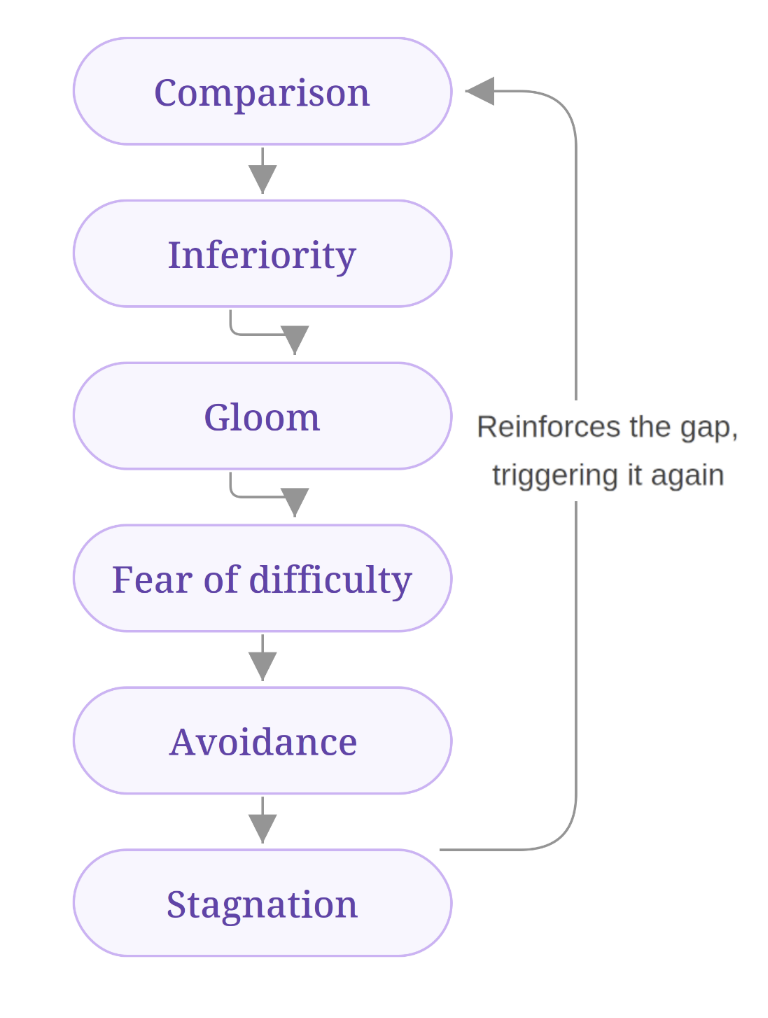
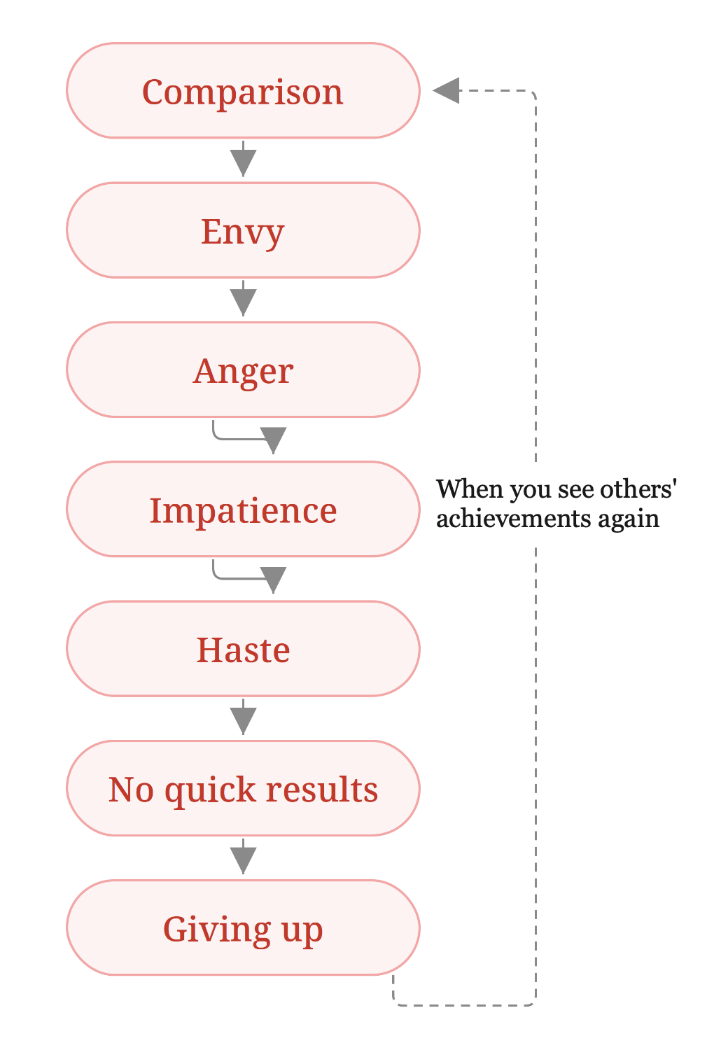
Both diagrams show that gloom and anger can each start from comparison. Comparison is a double-edged sword. Healthy comparison is a mirror: it shows where you stand, and may even inspire you to try something new. Excessive comparison is a swamp: it stirs up inferiority or envy and keeps you from acting — like someone swooping in to scold you while you were walking down the street minding your own business, then flying off again.
3 Calm and Steady ≠ Stuck and Avoiding
What does “the slower you go, the faster you get there” mean? Everyone knows the tortoise and the hare, yet it is hard to feel it personally: the story uses talking animals, and readers may not immediately connect a “race” to other parts of life. The same principle shows up in everyday practice, such as learning piano or drawing:
- It is tempting to rush, so beginners try to play along at the original tempo. At that speed you will make mistakes, and repeating a mistake hundreds of times wastes even more time training the wrong muscle memory. A few dozen repetitions at a tempo slow enough to play correctly work better.
- When drawing, it is tempting to start straight from imagination rather than copying, observing, and practicing fundamentals. The goal is to draw whatever you want from imagination, so you don’t want to stop and build foundations; wanting a finished picture every time is also a kind of rushing. As with piano, without observational copying practice it is hard to build muscle memory for correct structure, and drawing a hundred pictures from imagination before the basics are solid may only repeat the wrong muscle memory, with little progress.
So haste makes waste. Rushing not only lowers efficiency but also adds pressure and needless worry.
“Slow” is not “stopped.” I still remember a line from a workbook in high school: “I’m a slow walker, but I never walk backwards.” Calm and avoidance are easy to confuse, but they are completely different states. The “slow” in “the slower you go, the faster you get there” means not being disturbed by the outside world, not letting it shake your state of mind, and moving forward steadily every day. It does not mean dodging growth because you no longer want to face anxiety, and then giving up altogether. What drives steady daily progress, unmoved by others, is neither an intense craving for grand achievement nor the peer pressure and FOMO (fear of missing out) that comparison creates. It is focus on the small things in front of you. Action driven entirely by negative emotions like anxiety and fear of falling behind rarely lasts, and it can backfire: negative emotions pile up, may spill into your life and relationships, or may erupt later and bring everything to a sudden halt. Sustaining steady action over the long run takes positive feedback: curiosity, interest, a sense of accomplishment, and a sense of self-worth. Learning things you are interested in, or finishing small, easy tasks each day, brings small but immediate positive feedback. It adds up, and even a little positive feedback each day can lead you into a positive feedback loop. As Atomic Habits puts it, the sum of tiny improvements can have a bigger impact than you imagine. If you focus on a huge final achievement, every day before you reach it is a day you haven’t, which can create negative feedback. Instead, only by focusing on finishing small daily tasks, and letting curiosity (not utility) drive learning and practice, can you keep generating positive feedback.
4 The Power of Words
Today I renamed my “反思” (reflection, in the sense of self-examination) tag to “思考” (thinking). I never meant the tag as negative self-criticism — it was for observing and thinking about things — but “反思” can quietly suggest that I did something wrong and need to examine myself. So I changed it to “思考”.
5 The Calm That Comes from Writing and Reviewing
Writing this piece today helped me 1) notice my emotions and start thinking through their logic, and then 2) calm down and focus on what is in front of me. Writing really does help organize thoughts, restore reason, and sharpen logic. Even a quick note is better than no output at all.